1. Decide what you’ll clean and for whom
- Residential: house washing (soft wash), driveways and patios, decks and fences, roofs, gutters.
- Commercial: storefronts, sidewalks, dumpster pads, drive-thrus, parking garages, HOA common areas.
- Fleet: trucks and equipment, often on a recurring schedule and sometimes at night.
Starting with two or three services you can do well makes equipment, insurance and pricing simpler. Roof cleaning and commercial work often bring extra insurance questions, so decide early whether you’ll offer them.
☐ Pick your starting services ☐ Pick your service area ☐ Note which services you’ll add later
2. Register the business
Requirements vary a lot by location, so treat this as a list of questions to ask, not a list of answers.
- Business structure: sole proprietor, LLC or another form. Each has different liability and tax effects; a CPA or attorney can help you choose.
- Business name: if you operate under a name other than your own, you may need to register it (often called a DBA or fictitious name) with your state or county.
- EIN: the IRS issues Employer Identification Numbers free on IRS.gov. You’ll need one to hire, and many banks ask for one to open a business account.
- Local business license or tax receipt: check with your city and county.
- Contractor or trade licensing: some states or localities license certain cleaning or improvement work. Ask your state licensing board.
- Sales tax: whether cleaning services are taxable depends on your state. Check with your state revenue department.
- Wash water and runoff: many cities and counties regulate what can go into storm drains. Call your local stormwater or environmental office and ask what rules apply to wash water and chemicals, especially for commercial work.
☐ Choose structure ☐ Register name ☐ Get EIN ☐ Local license ☐ Ask about trade licensing ☐ Check sales tax ☐ Check runoff rules ☐ Open a separate business bank account
3. Get insured before the first job
Premiums depend on your location, services, revenue, equipment value and claims history, so get quotes from more than one agent who knows contractor coverage. The main types to ask about:
- General liability: covers third-party property damage and injuries, like a cracked window or a customer slipping on a wet surface. Many commercial clients and property managers will ask for a certificate of insurance before you start.
- Inland marine / equipment coverage: covers tools and equipment that move from job to job, such as your pressure washer, surface cleaner, pumps and trailer contents, if they’re stolen or damaged.
- Commercial auto: personal auto policies may not cover a vehicle used mainly for business or towing a rig. Ask your agent directly.
- Workers’ compensation: once you hire, your state may require it. Rules differ by state.
Ask every agent: are roof cleaning, work above a certain height, or chemical damage to plants and paint excluded? Exclusions matter more than the headline price.
☐ Get at least two quotes ☐ Confirm exclusions in writing ☐ Keep a certificate of insurance ready to send
4. Build your equipment list by category
Buy for the services you chose in step 1, not for every service you might offer someday.
- Pressure washer: match flow (GPM) and pressure (PSI) to your work. Flow matters most for cleaning speed on flat surfaces.
- Surface cleaner: for driveways, patios and sidewalks; much faster and more even than a wand.
- Soft wash setup: a low-pressure pump system or downstream injector for house washing and roofs.
- Hoses, reels, guns, wands and nozzles, plus extension wands for second stories.
- Water supply: a buffer tank so you aren’t limited by a customer’s spigot.
- Chemicals and storage: house wash mix, surfactants, degreasers, rust and stain removers, with proper labeled storage and the safety data sheets.
- Safety gear: eye protection, gloves, slip-resistant boots, and respiratory protection where the chemical label calls for it.
- Runoff control: drain covers or water recovery equipment if your local rules or commercial clients require it.
- Rig: a truck, trailer or skid setup that carries everything securely.
☐ Buy only what your starting services need ☐ Keep receipts and serial numbers for your equipment insurance
5. Set your prices from your own costs
Copying a rate from a forum is the fastest way to work hard for nothing. Build each rate from your production speed, your hourly cost to run and your chemical cost, then add margin and a minimum job charge. Our guide to quoting pressure washing per square foot walks through the formula.
A 2,000 sq ft house wash is 2,000 × $0.15 = $300. Add an 800 sq ft driveway at 800 × $0.13 = $104. Quote: $404.
A 300 sq ft patio alone is 300 × $0.13 = $39, below your minimum, so the quote is $175, or you offer a patio-plus-walkway package that clears the minimum on its own.
☐ Time yourself on each surface ☐ Set a rate per surface ☐ Set multipliers for heavy staining and hard access ☐ Set a minimum job charge
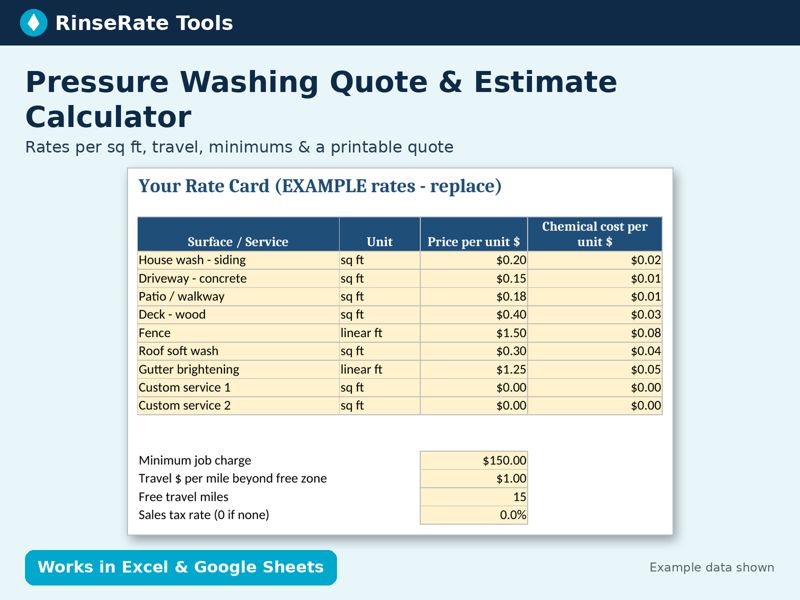
Template: Pressure Washing Quote & Estimate Calculator (Sq Ft)
Set your rate per square foot or linear foot for 9 surfaces, type measurements on site, and get a totaled estimate with travel, minimum-job adjustment, tax and your internal chemical cost. A printable quote tab fills itself.
Excel + Google Sheets. Regular price $15; check the listing for current price. Example data is labeled; replace it with your own numbers.
Get the template on Payhip Or on Gumroad6. Write clear quotes and invoices
Use the same line items on the quote and the invoice: each surface with quantity, unit and rate, then travel, any minimum adjustment, tax if your state requires it, deposit and balance due. State what isn’t included, such as rust or oxidation that may not come out. Set payment terms up front: due on completion is common for homeowners, while commercial clients may need Net 15 or Net 30. See how to write a pressure washing invoice for a full sample layout.
☐ Quote template ☐ Invoice template with numbering ☐ Payment methods set up ☐ A simple register of who owes what
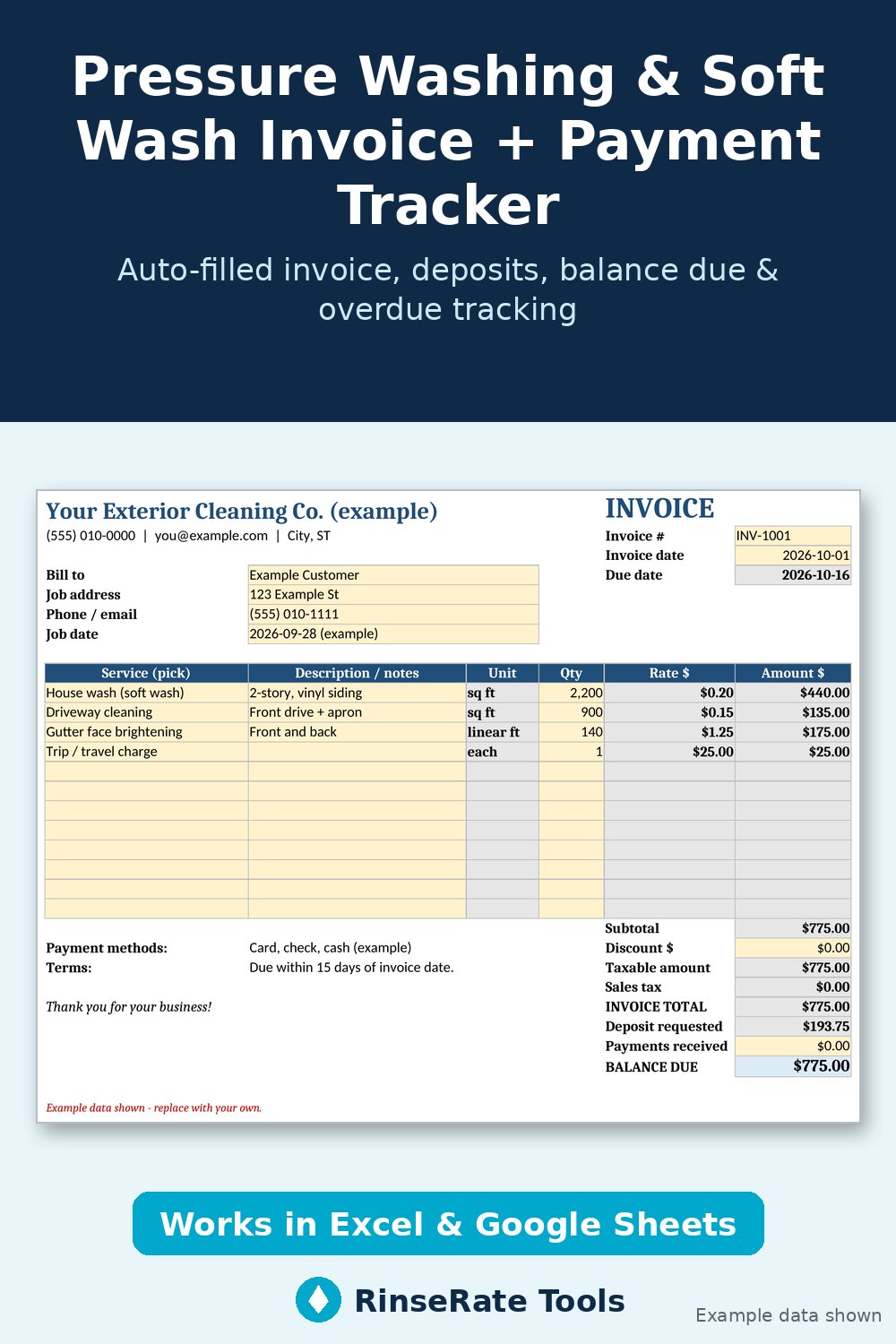
Template: Pressure Washing & Soft Wash Invoice + Payment Tracker
Enter your business info and price list once. Pick a service, type the quantity, and the invoice fills in rate, subtotal, discount, sales tax, deposit and balance due. The Invoice Register tracks payments, works out due dates from your terms, flags Paid / Open / OVERDUE and totals what’s outstanding.
Excel + Google Sheets. Regular price $12; check the listing for current price. Example data is labeled; replace it with your own numbers.
Get the template on Payhip Or on Gumroad7. Choose your software (or not yet)
Many new operators can start with a spreadsheet for quotes, invoices and job tracking, plus a calendar and a payment app. Software starts to pay when reminders, online booking, rescheduling and invoice follow-ups take real time each week. Our guide on spreadsheet vs field service software has a cost framework to decide.
Some links are affiliate links; we may earn a commission at no cost to you. Details
When you’re ready, these are the three we compare most for exterior cleaning. Entry prices from each vendor’s pricing page (checked Oct 2026): Jobber Core at $29/mo billed annually ($49/mo with no commitment, 1 user); Housecall Pro Basic at $59/mo billed annually; and GorillaDesk Basic at $49/mo paid monthly for one route, with unlimited free users and the option to freeze the account in a slow season. See our full pressure washing software comparison for which features sit on which plan.
☐ Decide spreadsheet, software or both ☐ If software, run the free trial on real jobs
8. Land your first customers
- Google Business Profile: it’s free. Add your services, service area, hours and photos, and ask every happy customer for a review.
- Before-and-after photos: take them on every job from the same angle. They’re your best ads on your profile, social media and quotes.
- Work the street you’re on: after a job, leave door hangers or flyers on nearby homes. Neighbors can see the clean driveway, which makes the pitch easy.
- Local groups and apps: neighborhood apps and community groups, following each group’s rules on business posts.
- Referral partners: real estate agents (listing prep), property managers (move-outs and annual cleaning), HOAs, painters and window cleaners.
- Commercial walk-ins: storefronts, restaurants and gas stations with visibly dirty sidewalks or dumpster pads. Bring a printed quote with a recurring option.
- Referral offer: a set discount for both the customer and the friend they send.
- Seasonal pushes: spring cleaning, pre-holiday house washes and pre-listing cleaning are natural reasons to reach out.
☐ Google Business Profile live ☐ Photo routine ☐ Door hangers printed ☐ Five referral partners contacted ☐ Review request routine
9. Track profit from week one
Log every job’s price, hours, chemicals and miles, and every expense. After a month, check your average profit per job and adjust prices before bad habits set in. The job costing guide shows a simple monthly routine that works for any wash or cleaning business.
Turn your labor, overhead, travel and chemical costs into a suggested price for every service before you quote your first job. Excel + Google Sheets + printable PDF. Pay what you want, $0 minimum.
Get the free price sheet