 RinseRate Tools
Disclosure: Some links on this page are affiliate links. If you buy through them, RinseRate Tools may earn a commission at no extra cost to you. We only recommend tools we’ve researched, and our ranking isn’t paid. Full disclosure.
How to Quote Pressure Washing Per Square Foot
Square-foot pricing is popular in pressure washing for a good reason: it scales with the job and it’s easy to explain to a customer. The mistake is copying someone else’s rate from a forum. A per-square-foot rate only works if it’s built from your production speed, your chemical costs and your overhead.
Step 1: Find your production rate per surface
Production rate is how many square feet you clean per hour on each surface with your equipment. A surface cleaner on flat concrete moves far faster than hand-wanding a stained deck. Time yourself on a few real jobs per surface and write it down. Track setup and breakdown separately, since they don’t scale with size.
Step 2: Know your hourly cost to run
Add your labor (yours or your crew’s, with payroll costs), plus rig costs per hour: fuel for the truck and machine, maintenance, insurance, and equipment payments spread across your working hours. Then add overhead per hour: phone, software, marketing, accounting.
Step 3: Turn it into a rate
Cost per sq ft = Hourly cost to run ÷ Production rate (sq ft/hr) + Chemical cost per sq ft
Rate per sq ft = Cost per sq ft ÷ (1 − target margin)
Hypothetical example: your hourly cost to run is $75, you clean flat concrete at 1,000 sq ft per hour, and chemical cost is $0.01 per sq ft. Cost is $0.075 + $0.01 = $0.085 per sq ft. At a 35% target margin, the rate is $0.085 ÷ 0.65 = about $0.13 per sq ft. A house wash with a slower production rate and more chemical will come out higher. Run each surface separately.
Step 4: Use surface multipliers for hard jobs
Instead of a separate price list for every situation, keep a base rate per surface and apply multipliers:
- Condition: heavy oil staining, rust, years of buildup (for example 1.25× to 1.5×).
- Access: second story, steep slopes, tight side yards, long hose runs.
- Delicate surfaces: wood, composite, painted surfaces that need low pressure and more care.
- Water source: no spigot means bringing water, which adds time.
Write your multipliers down and use them the same way every time, so two similar jobs get similar quotes.
Step 5: Linear-foot items
Fences, gutters and curbs are faster to quote by linear foot. Build those rates the same way: time a few, add chemical, add margin.
Step 6: Measure accurately
- Driveways and patios: length × width per rectangle, then add the rectangles. Subtract big planters.
- House siding: perimeter × wall height, then subtract roughly for large windows and garage doors if you don’t clean them. Gables need extra triangles (½ × base × height).
- Online satellite and map measuring tools help for estimates, but confirm on site before final pricing.
Step 7: Always set a minimum
A 200 sq ft patio at $0.13 is $26, which won’t cover your drive and setup. Set a minimum job charge from your cost of a trip: drive time, setup, breakdown and a little cleaning time. Many operators also bundle small items into a package so the ticket clears the minimum naturally.
Step 8: Put it in a clear written quote
List each surface with measured quantity, rate and line total. Then travel, minimum adjustment if any, tax if it applies in your state, and the total. Add what’s not included, such as removing heavy rust or oxidation. A clear quote means fewer disputes later.
Tools that help
Once your rates are set, field service software can store them in a price book and send quotes for you. Housecall Pro lists a price book and estimates on its Basic plan ($59/mo billed annually) (checked Oct 2026). GorillaDesk lists Map Estimation Tools for measuring properties on its Growth plan ($149/mo per route, paid monthly) (checked Oct 2026). Compare the bigger names in our Jobber vs Housecall Pro guide.
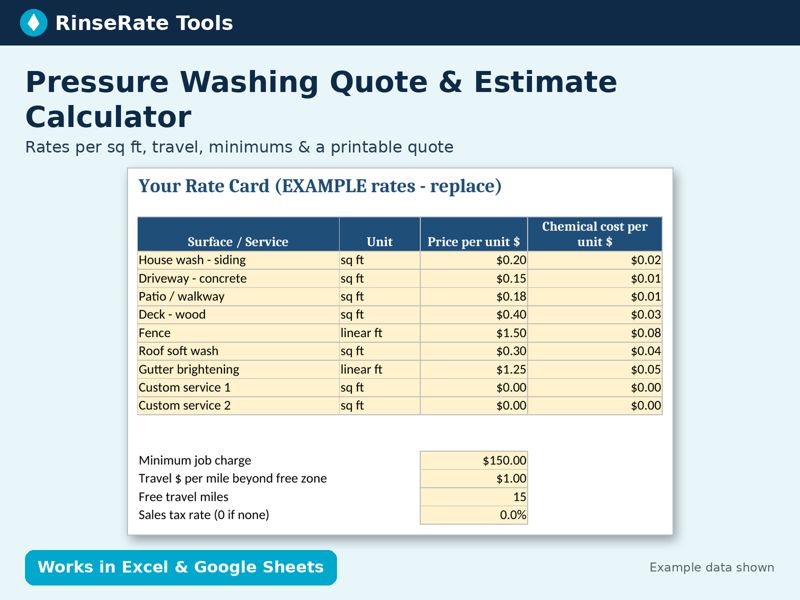
Template: Pressure Washing Quote & Estimate Calculator (Sq Ft)
Set your rate per square foot or linear foot for 9 surfaces, type measurements on site, and get a totaled estimate with travel, minimum-job adjustment, tax and your internal chemical cost. A printable quote tab fills itself.
Excel + Google Sheets. Regular price $15; check the listing for current price. Example data is labeled; replace it with your own numbers.
Get the template on Payhip