Per pane vs per hour at a glance
| Per pane (or per window) | Per hour | |
|---|---|---|
| Easy for the customer to compare | Yes. A count times a price is easy to explain on the phone. | Less so. Customers worry about the clock running. |
| Rewards a fast, efficient crew | Yes. Get faster and you earn more per hour. | No. Get faster and the ticket shrinks. |
| Protects you on slow, dirty, awkward jobs | Only if you add multipliers and add-ons. | Yes, automatically. |
| Needs an accurate count up front | Yes. | No, but you need a good time estimate to quote. |
| Common weak spot | Forgetting the cost of getting to the job and setting up. | Forgetting drive time and overhead in the hourly rate. |
Step 1: Know your fully loaded cost per worker-hour
Start with what one hour of one worker costs you. For an employee, that’s the wage plus payroll taxes, workers’ comp and any other per-hour costs. If it’s just you, pick the hourly pay you want and treat it as a cost, not as profit. Then add overhead: insurance, phone, software, marketing, ladders, poles, water-fed pole systems and their upkeep. A simple way is to add overhead as a percentage of direct cost.
Hypothetical: labor cost $25 per worker-hour, overhead 15%. Fully loaded cost = $25 × 1.15 = $28.75 per worker-hour.
To earn a 35% margin on that hour, you need $28.75 ÷ (1 − 0.35) = about $44.23 per worker-hour. Note it’s divided by 0.65, not multiplied by 1.35.
Step 2: Time your work per item
This is the step most people skip, and it’s the one that makes per-pane pricing safe. On a few real jobs, time how long one worker takes per unit for each item type, and write down exterior and interior separately:
- Standard panes (typical double-hung or slider sashes).
- French panes: count each small lite, not the whole window. A French door with 15 lites is much slower than one big pane.
- Large picture windows and sliding doors.
- Skylights (often need roof access or an extension pole).
- Screens (remove, clean, refit) and tracks and sills, counted per unit, not per side.
Average at least three jobs per item. Keep setup and teardown (ladders, hose, water-fed pole, drop cloths) separate, because they don’t scale with the number of panes.
Step 3: Build a per-pane rate from your minutes
Price per pane = Fully loaded cost per worker-hour × (minutes per pane ÷ 60) ÷ (1 − target margin)
Hypothetical: if a standard exterior pane takes 4 minutes, that’s 15 panes per worker-hour. At $28.75 per hour and a 35% margin, the floor is about $2.95 per pane. If you charge $3.50, that item earns $52.50 per worker-hour, above the $44.23 target. If tracks take 3 minutes and you charge $2.00, they earn $40 per worker-hour, under target. Check every item on your price list this way. Items that look cheap to the customer are often the ones priced below your cost.
Step 4: Add a trip and setup charge (or a minimum)
Here’s the gap that catches per-pane pricing. Pane rates pay you for time on the glass. They don’t pay for the drive, loading and unloading, setup, travel costs or supplies. On small jobs those fixed costs can be most of the cost. There are two common fixes:
- A trip/setup charge on every job, built from drive time, setup time, vehicle cost and supplies, plus overhead and margin.
- A minimum job charge so a five-pane job still covers the visit.
Many operators use both: a built-in trip charge on every quote and a minimum for very small jobs.
Step 5: Apply story multipliers and condition add-ons
- Height: second- and third-floor glass takes longer (ladder moves, pole work, more care). Use a time multiplier, for example 1.25× for the 2nd floor and 1.5× for the 3rd, and adjust after timing your own jobs. Apply it to the count, not to the whole ticket.
- First-time or heavy buildup clean: glass that hasn’t been cleaned in years, paint overspray or construction residue takes longer than maintenance cleans. A time uplift (for example 25%) on the first visit is easier to explain than a higher base price.
- Hard-water stain removal: quote it as a separate add-on, per pane, with its own time per pane. Results vary with how long the stains have been there, so test a small area first and set expectations in writing. Some tempered glass can scratch when scraped with a razor, so many cleaners test, avoid blades on tempered glass, and get sign-off before starting.
- Access: steep lots, landscaping beds, furniture to move inside, or no spot for the ladder all add time.
Step 6: Set an hourly rate that covers everything
If you price per hour, the rate has to cover more than the time on site. Either bill drive and setup time too, or set your on-site rate high enough to absorb them. The number from Step 1 ($44.23 in the example) only covers labor and overhead on site. Travel costs, supplies and drive time come on top.
Worked example (hypothetical): one job, three prices
A one-story home, 30 standard panes inside and out, plus 14 screens. Crew of 2, using the hypothetical numbers above. Timed rates: 4 minutes per pane exterior, 3 minutes interior, 2 minutes per screen. Setup and teardown 15 minutes per worker. Round-trip drive 30 minutes. Travel cost $15, supplies $6. Price list: $3.50 per pane exterior, $2.50 interior, $1.50 per screen. Hourly billing rate: $55 per worker-hour on site.
| Line | Example figure |
|---|---|
| Glass and screens: 30 × (4 + 3) + 14 × 2 minutes | 238 worker-minutes (about 3.97 hours) |
| Setup and teardown: 0.25 hours × 2 workers | 0.5 worker-hours |
| On-site worker-hours | about 4.47 (about 2.2 hours on site for the crew) |
| Drive: 0.5 hours × 2 workers | 1.0 worker-hour |
| Labor: 5.47 worker-hours × $25 | about $137 |
| Travel + supplies | $21 |
| Overhead at 15% of direct cost | about $24 |
| Total cost | about $181 |
| Method | Price | Profit | Margin |
|---|---|---|---|
| Cost-plus at 35% margin ($181 ÷ 0.65, rounded up to $5) | $280 | about $99 | about 35% |
| Per-pane price list: 30 × ($3.50 + $2.50) + 14 × $1.50 | $201 | about $20 | about 10% |
| Per hour: 4.47 on-site worker-hours × $55 | about $246 | about $64 | about 26% |
The per-pane list itself isn’t the problem in this example. On the glass alone it earns well above cost. What’s missing is the fixed cost of the visit: drive, setup, travel and supplies. Built the same way as the pane rates, a trip and setup charge here comes to about $104 at a 35% margin ((drive $25 + setup $12.50 + travel $15 + supplies $6) comes to roughly $100 at a 35% margin, which brings the per-pane quote to about $301#215; 1.15 comes to roughly $100 at a 35% margin, which brings the per-pane quote to about $301#247; 0.65), which brings the per-pane quote to about $305. The hourly rate falls short for the same reason: $55 an hour on site doesn’t pay for the drive. To hit 35% on this job by the hour alone, the rate would need to be about $62 per worker-hour on site.
Which method should you use?
- Residential, mostly maintenance cleans: per pane with a trip charge and minimum is easy to sell and rewards an efficient crew.
- Post-construction, heavy buildup or unusual access: per hour (or per pane with clear uplifts) protects you when the time is hard to predict.
- Recurring storefront routes: a flat price per visit, built from timed visits plus a share of the drive between stops.
A practical hybrid: quote per pane so the customer sees a clear count, then check the total against your hours and cost before you send it. If the per-pane total falls below your cost-plus price, raise the trip charge or the add-ons, not just the pane rate.
Counting accurately
- Ask for photos of each side of the home, or check online listing photos and street-level imagery for a first count. Confirm on site before you start.
- Count by floor so story multipliers apply to the right glass.
- List screens, tracks and hard-water panes as separate lines on the quote, so the customer sees exactly what’s included.
Related guides
- How to quote pressure washing per square foot: the same production-rate method for house washes, concrete and fences, if you offer exterior cleaning beyond glass.
- Job costing and monthly profit: track what each job actually cost after it’s done, so your timed rates stay honest.
- Jobber vs Housecall Pro for exterior cleaning: once your rates are set, software can store them in a price book and send quotes.
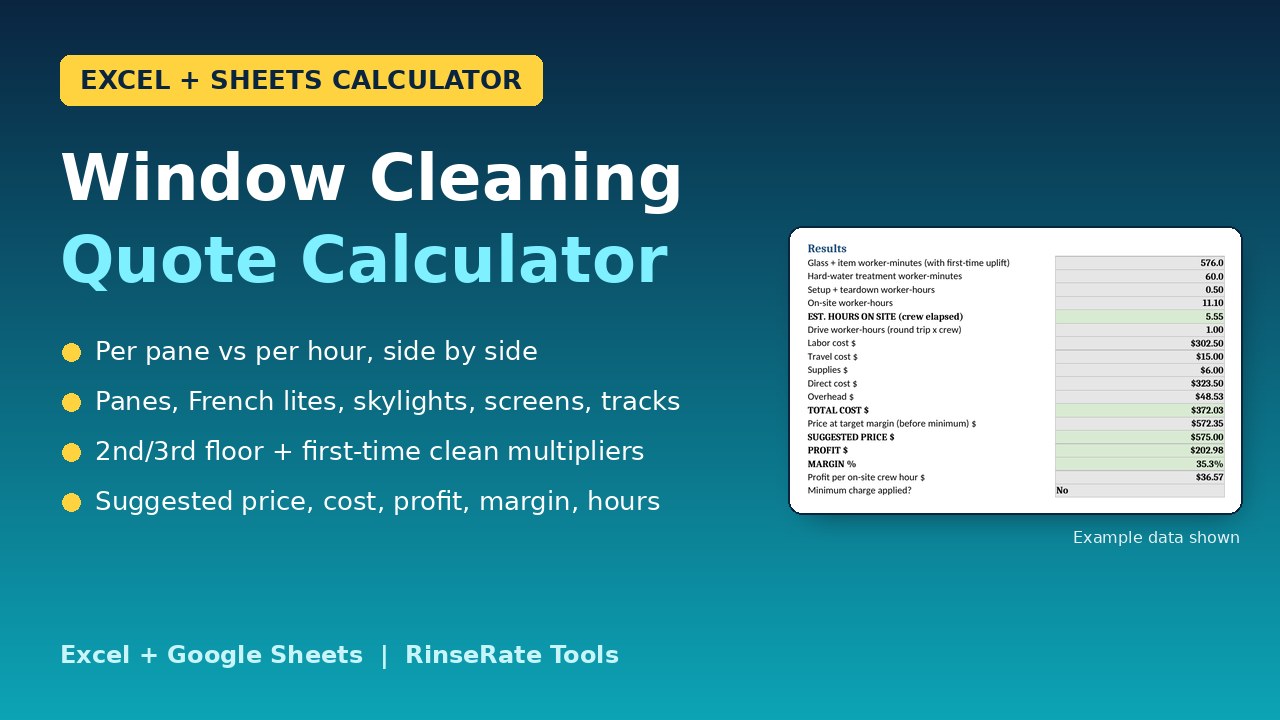
Template: Window Cleaning Quote Calculator (Per Pane vs Per Hour)
Enter your labor cost, crew size, travel, overhead, target margin and minimum once. Type pane counts by floor (standard, French, picture windows, skylights, screens, tracks) and get a suggested price, cost, profit, margin and hours on site, with the same job priced per pane and per hour side by side.
Excel + Google Sheets. Regular price $9; check the listing for current price. Example data is labeled; replace it with your own numbers.
Code RINSE20: 20% off at Payhip checkout through Nov 23, 2026.
Get the template on PayhipQuestions or a correction? Email hello@rinseratetools.com.
Get the whole pressure washing toolkit
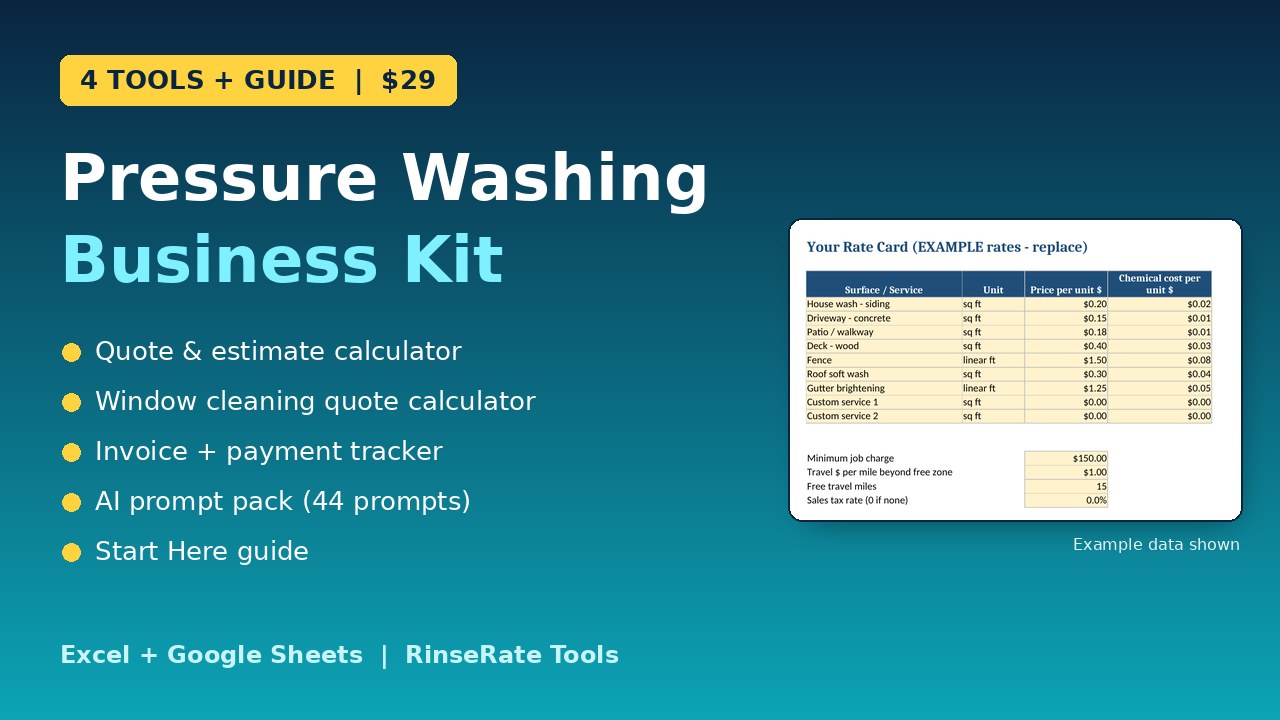
Kit: Pressure Washing Business Kit
Four tools in one download: the Pressure Washing Quote & Estimate Calculator, Window Cleaning Quote Calculator, Pressure Washing & Soft Wash Invoice + Payment Tracker and the Pressure Washing AI Prompt Pack (44 prompts), plus a 1-page Start Here guide.
Excel + Google Sheets + PDF. $29 for the kit ($43 if bought separately); check the listing for current price. Prompts written with AI assistance and reviewed by a person.
Code RINSE20: 20% off at Payhip checkout through Nov 23, 2026.
Get the kit on Payhip