The formula in three steps
- Cost per ounce of concentrate = jug price ÷ jug size in fluid ounces. A gallon is 128 fl oz.
- Cost per ounce of mixed solution = cost per oz of concentrate ÷ (1 + parts water). A 1:10 ratio means 1 part product to 10 parts water, so divide by 11. Products used straight have a ratio of 0, so divide by 1.
- Cost per car = mixed ounces used on one car × cost per mixed ounce, added up for every product in that service.
Then add a waste buffer for spills, foam cannon leftovers and product you mix but don’t use. Pick a percentage that matches what you actually see; measure it rather than assume it.
A worked hypothetical example
Hypothetical: a gallon of wash soap costs $40 and you dilute it 1:32.
- Concentrate: $40 ÷ 128 oz = $0.3125 per oz
- Mixed: $0.3125 ÷ 33 = about $0.0095 per oz
- 64 oz of mixed soap on one car = about $0.61
Do the same for each product in the service. In this made-up basic wash, adding wheel cleaner (16 oz mixed at 1:4 from a $35 gallon), tire dressing (2 oz used straight from a $30 gallon) and glass cleaner (3 oz straight from a $25 gallon) gives:
| Product | Jug | Ratio | Mixed oz per car | Cost per car |
|---|---|---|---|---|
| Wash soap | $40 / 128 oz | 1:32 | 64 | $0.61 |
| Wheel cleaner | $35 / 128 oz | 1:4 | 16 | $0.88 |
| Tire dressing | $30 / 128 oz | straight | 2 | $0.47 |
| Glass cleaner | $25 / 128 oz | straight | 3 | $0.59 |
| Total | $2.54 |
With a 10% waste buffer that’s about $2.79 per car. Notice that the two ready-to-use products cost nearly as much as the two diluted ones. Straight products are often where the money goes.
How to measure ounces per job
- Fill your sprayer, foam cannon or bucket to a marked line. Do one car. Measure what’s left.
- Repeat on three jobs of the same service and vehicle size and average them.
- Measure again for SUVs and trucks; larger vehicles use more product. If you charge size tiers (see our price list guide), cost each tier.
- Check the label: the manufacturer’s ratio is a starting point, and heavy soil may need a stronger mix.
From cost per car to a monthly number
Multiply each service’s chemical cost by how many of that service you do in a month, then add them up. In the hypothetical above, 60 basic washes at about $2.79 is about $167 a month in chemicals for that service alone. Compare the monthly total with your actual supply receipts. If receipts run higher, your ounces-per-job numbers are low or waste is higher than you think.
Two quick checks are worth running:
- Chemical cost as a % of price. It tells you which services are product-heavy. A low-priced service with a lot of straight product can look busy and earn little.
- Cost per wash in a membership. If you sell unlimited plans, your chemical cost per visit is a key input to the membership break-even.
Common mistakes
- Dividing by the ratio number instead of ratio + 1 (1:10 means 11 parts total).
- Mixing up concentrate ounces and mixed ounces in the same column.
- Using the price from your first order and never updating it.
- Leaving out towels, pads and other consumables. Track them as a separate supplies line in your job costing.
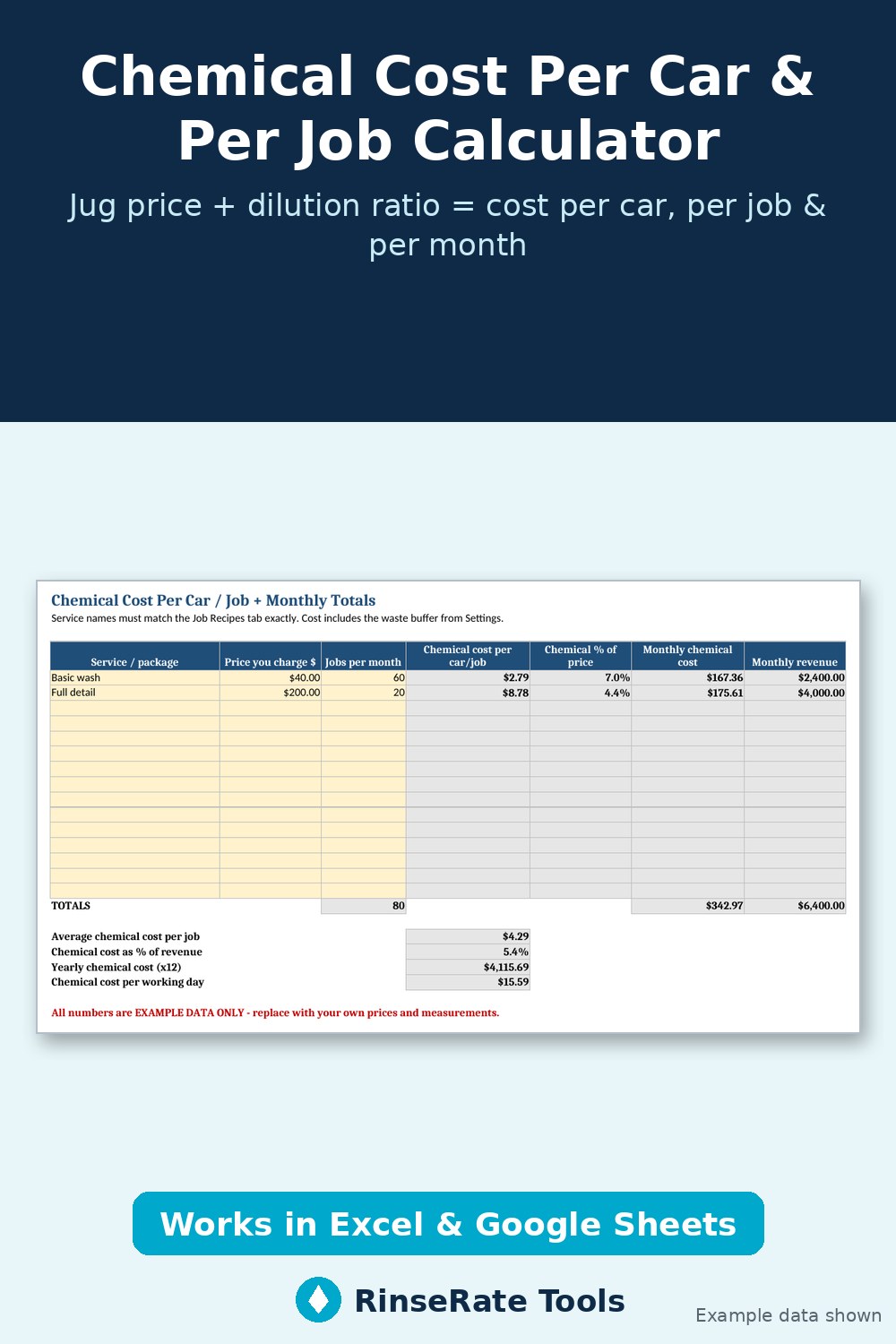
Template: Chemical Cost Per Car & Per Job Calculator
List each product with jug price, jug size and dilution ratio. Build a recipe for each service in mixed ounces. See chemical cost per car or job, chemical % of price, and monthly and yearly chemical spend, with a waste buffer built in.
Excel + Google Sheets. Regular price $9; check the listing for current price. Example data is labeled; replace it with your own numbers.
Get the template on PayhipQuestions or a correction? Email hello@rinseratetools.com.