 RinseRate Tools
Disclosure: Some links on this page are affiliate links. If you buy through them, RinseRate Tools may earn a commission at no extra cost to you. We only recommend tools we’ve researched, and our ranking isn’t paid. Full disclosure.
How to Price Mobile Detailing Jobs
Most detailers price by looking at what others in town charge and going a little lower. That tells you what customers might pay. It doesn’t tell you whether you make money. The safer method is to build a price from your own costs up, then compare it to the market. If the market won’t pay your cost-based price, you need to cut costs, change the package or find different customers, not just work for less.
Step 1: Put a real price on your time
Decide what an hour of your labor is worth, including the hours you aren’t paid for. If you’re solo, include time spent booking, driving, restocking and cleaning towels. A simple way: pick the yearly pay you want, then divide by the hours you can realistically bill. If you want to earn $50,000 and can bill about 1,250 hours a year (25 hours a week for 50 weeks), your labor cost is $40 an hour. If you pay a tech, use their wage plus payroll costs.
Step 2: Cost your products per job
Take each product you use, the price you paid and how many jobs it lasts. A gallon of all-purpose cleaner that costs $30 and covers about 30 interiors is $1 a job. Do this for soap, wheel cleaner, dressing, glass cleaner, interior protectant, clay, polish and pads. Add towel wear and replacement. Many detailers are surprised that a full detail uses $8 to $15 of product once everything’s counted. Do the math on yours; it varies a lot with product choice.
Step 3: Cost the drive
Mobile work has a cost a shop doesn’t: getting there. Count miles round trip times a per-mile cost (fuel, maintenance, tires, insurance, and depreciation on the rig), plus the drive time at your labor rate. Many operators set a free service radius and add a travel fee beyond it.
Step 4: Spread your overhead
Overhead is everything you pay whether or not you work: insurance, phone, software, marketing, equipment payments, water tank and generator upkeep. Add it up per month and divide by the jobs you expect to do that month. $900 of overhead across 60 jobs is $15 per job. In slow months the per-job overhead goes up, which is why winter pricing feels tighter.
Step 5: Add your target margin
Total cost isn’t your price. Your business needs profit on top of your pay to replace equipment, survive slow weeks and grow. Pick a target margin, then price with this formula:
Price = Total cost ÷ (1 − target margin)
A 30% margin means dividing by 0.70, not multiplying by 1.30. Multiplying gives you a lower price and a smaller margin than you think.
Worked example (hypothetical)
| Line | Example figure |
|---|---|
| Labor: 3 hours on site at $40/hr | $120 |
| Drive: 30 minutes at $40/hr | $20 |
| Mileage: 20 miles at $0.60/mile | $12 |
| Products and towels | $12 |
| Overhead share | $15 |
| Total cost | $179 |
| Price at 30% target margin ($179 ÷ 0.70) | about $256 |
So in this example, a full detail priced at $180 would only cover cost. That’s the most common finding when people run these numbers for the first time.
Step 6: Adjust for vehicle size and condition
Price by time, not by vehicle label. If a third-row SUV takes 40% longer than a sedan, use a 1.4 size multiplier on the labor portion. Pet hair, sand and heavy staining are add-ons with their own time estimate. Put these in writing on your booking page so you can charge for them without an argument in the driveway.
Step 7: Set a minimum charge
A $50 exterior wash 25 minutes away might lose money once you count drive time. A minimum job charge, or a minimum per stop, protects you. Multi-car stops at one address are where mobile detailing gets efficient, so discount the second car rather than the first.
Step 8: Compare to the market and decide
Now look at local prices. If your cost-based price is well above the market, check which input is out of line: maybe you’re slow on interiors, your drive radius is too big, or your overhead is heavy for your volume. If it’s well below the market, you may be undercharging.
Where software fits
Field service apps like Jobber list job costing on higher plans (Grow and up when we checked) (checked Oct 2026). They track costs after the job. You still need to know your numbers before you set package prices, and for that a spreadsheet is the simplest tool. See our software comparison for detailers when you’re ready.
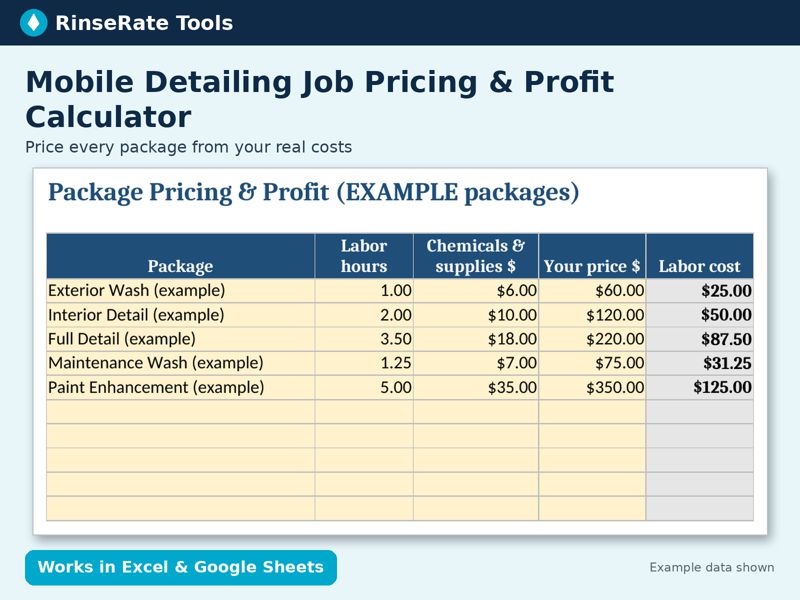
Template: Mobile Detailing Job Pricing & Profit Calculator
Enter your labor rate, chemical cost, travel cost per mile and overhead once. See true cost, profit, margin, profit per hour and a suggested price for each package, plus a one-job quote tab with vehicle-size multipliers and add-ons.
Excel + Google Sheets. Regular price $14; check the listing for current price. Example data is labeled; replace it with your own numbers.
Get the template on Payhip