 RinseRate Tools
How to Price a Car Wash Unlimited Membership
An unlimited plan trades a fixed monthly payment for an unknown number of washes. That’s a good deal for you when members wash a few times a month and a bad one when a plan is underpriced for the heaviest users. Pricing it well comes down to three numbers you can measure yourself: what one wash costs you, how often members actually come, and what you charge for a single wash today.
Step 1: Find your true cost per wash
This is the variable cost of putting one more car through, not your rent or loan payment. Add up, per car:
- Chemicals: divide what you spent on soaps, waxes, tire shine and so on last month by the cars washed that month. Do it per package if your top package uses more product.
- Water and sewer: monthly bill divided by cars washed (or use your reclaim system’s numbers if you meter it).
- Electricity and gas for the tunnel, dryers and water heating, the same way.
- Supplies and wear: towels, brushes and wear parts, spread over cars washed.
Use several months if you can, since cold or slow months skew one-month numbers. Labor is often left out because attendants are paid whether a member or a retail customer comes through. If a busier tunnel would mean adding staff, include a labor share.
Step 2: Estimate how often members will wash
Frequency drives everything. If you already sell memberships, pull visits per member per month from your POS or license-plate system and look at the spread, not just the average. A handful of daily washers can pull the average up. If you’re launching, you don’t have this data yet. Pick a cautious estimate, then plan to recheck it after the first two or three months.
Step 3: Work out the two break-even visit counts
Two numbers frame your price:
| Number | Formula | What it tells you |
|---|---|---|
| Customer break-even | Plan price ÷ single-wash price | How many washes a month before the plan is a better deal than paying each time. This is the number in your sales pitch. |
| Your break-even | (Plan price × (1 − card fee %)) ÷ cost per wash | How many washes a month before a member costs you more than they pay. You want this well above what your typical member does. |
Customer break-even: $40 ÷ $20 = 2 washes. Wash twice and the plan pays for itself.
Your net per member: $40 × 0.97 = $38.80. Your break-even: $38.80 ÷ $3.40 = about 11.4 washes a month.
At 3 washes a month, profit per member is $38.80 − (3 × $3.40) = $28.60.
The gap between those two counts is your room. A plan the customer sees as a deal at 2 visits and that still makes money at 10 or more is very different from one that turns unprofitable at 5.
Step 4: Compare against what those same customers pay now
If a regular already washes three times a month at $20, moving them to a $40 plan lowers what they pay you that month. Memberships usually make sense because of steadier revenue and keeping customers, not because each existing regular pays more. Run the numbers both ways: revenue from members on the plan vs. what the same washes would bring in at retail. If most of your early signups are existing heavy regulars, expect a revenue dip until new members join.
Step 5: Account for cancellations
Members cancel. A monthly cancellation (churn) rate is the share of members who leave each month. Even a modest rate compounds: at 8% a month (an example, not a benchmark), a group of 100 members is down to about 37 a year later if nobody new joins. Your growth plan needs enough new signups each month to more than replace those who leave. Measure your own rate from your membership software once you have a few months of data.
Step 6: Build tiers that map to your wash menu
Most clubs tie each plan to a wash package. A few practical rules:
- Keep the customer break-even simple. A plan that pays off at about two visits is easy to explain at the pay station.
- Check each tier on its own. Top packages use more product, so their cost per wash and your break-even differ from the basic plan.
- Price the gap between tiers by cost and perceived value, not just a round $10 step. If the top tier only costs you a little more per wash, it can carry the best margin.
- Decide your rules up front: one car per plan, how plates or RFID tags get swapped, family add-on pricing, and whether you allow pausing.
Step 7: Recheck after launch
Once the plan has been running a couple of months, replace your estimates with real data: actual visits per member, actual cost per wash, actual cancellations. Then rerun the math. If the heaviest users are pushing your cost up, look at fair-use rules or the price of the top tier before cutting the plan.
Do it in a spreadsheet
You can do all of this on paper, but a spreadsheet lets you test prices in seconds. Our template sets up the math for three tiers, including a frequency test from 1 to 12 washes a month and a 12-month projection with signups and cancellations.
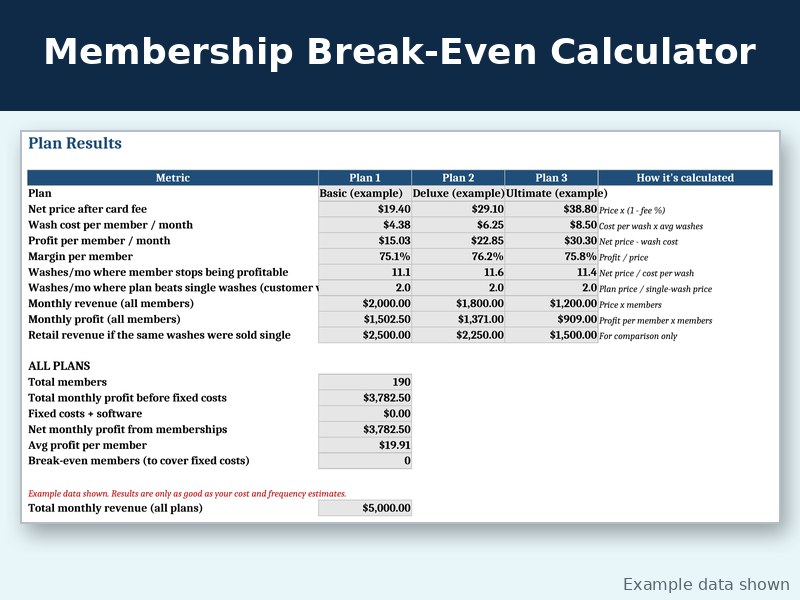
Template: Car Wash Unlimited Membership Break-Even Calculator
Enter up to 3 plans with price, matching single-wash price, cost per wash, members and average visits. See profit per member, the visit count where a member stops being profitable, break-even members, a 1–12 wash frequency test with a chart, and a 12-month signup and cancellation projection.
Excel + Google Sheets. Regular price $19; check the listing for current price. Example data is labeled; replace it with your own numbers.
Get the template on PayhipThe template link goes to our Payhip store. Example data in the template is labeled; replace it with your own.
Related guides
- Car Wash & Detailing Job Costing: Track Cost per Car and Monthly Profit covers how to find your real cost per car, the key input above.
- How to Price Mobile Detailing Jobs